SEOApex · 10/25/2026
Content Clusters for SEO: AI-Powered Strategy Guide 2026
Learn how AI-powered content clusters boost SEO rankings and generative engine visibility. Practical strategy for small businesses and agencies.
Ready to see SEOApex in action?
AI-powered SEO & generative engine optimisation (GEO) software — daily SEO articles, hosted blogs, backlinks and AI visibility tracking for small businesses and agencies — see it for yourself.
Visit seoapex.co.ukKey takeaways
- •Content clusters organise related topics around a pillar page, signalling topical authority to Google and AI search engines
- •AI tools now automate cluster mapping, keyword gap analysis and content interconnection—saving weeks of manual planning
- •Generative engine optimisation (GEO) favours deep, interlocked content; clusters satisfy both Google's E-E-A-T signals and AI model training data preferences
- •Small teams can implement clusters in 6–8 weeks using AI-assisted workflows, without hiring specialist SEO staff
What Are Content Clusters and Why They Matter Now
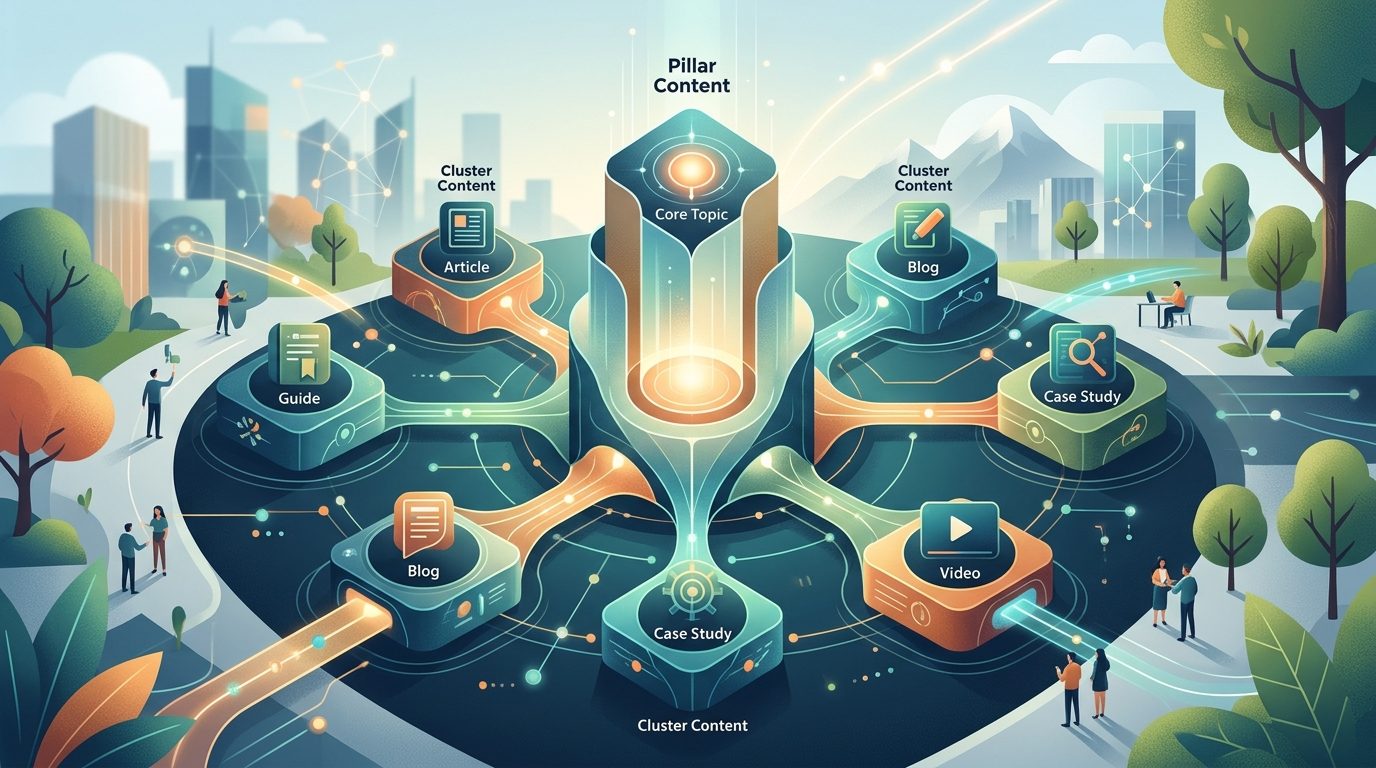
Content clusters are topic groups built around a core 'pillar' page that covers a broad subject comprehensively. Surrounding 'cluster' pages dive deep into subtopics, each linking back to the pillar and to each other. Google rewards this structure because it demonstrates topical depth—a key ranking factor since 2024.
But clusters do more than please Google. Generative engines like ChatGPT, Perplexity and Gemini train on interconnected, authoritative content. When cluster pages cite and reference each other naturally, they create a knowledge graph that AI models recognise as trustworthy. This is generative engine optimisation (GEO).
For a busy founder or agency, clusters replace guesswork. Instead of publishing random blog posts and hoping they rank, you build a strategic map: pillar → clusters → internal links → keyword saturation. The result: faster rankings, better visibility in AI citations, and proof of expertise that attracts both human visitors and AI recommendations.
How AI Accelerates Cluster Planning and Execution
Historically, cluster mapping meant hours in spreadsheets and competitor analysis tools. Today, AI rewrites that workflow.
Automated Cluster Discovery. AI can scan your website, competitor domains and search intent data to recommend pillar topics and logical cluster breakdowns. Tools analyse search volume, question patterns and SERP structure to suggest which subtopics rank best and where gaps exist.
Keyword Clustering at Scale. Instead of manually grouping 200 keywords, AI clusters them semantically—grouping not just by exact match but by intent and conceptual relationship. This ensures cluster pages target genuinely distinct topics, not cannibalising each other's rankings.
Content Brief Generation. AI now produces cluster briefs that outline structure, key statistics, internal link anchors and word targets per page. Many platforms (including SEOApex) now integrate this into their recommendation engines, feeding data directly into your content calendar.
Link Architecture Mapping. AI predicts the optimal internal link topology: which pages should link where to maximise topical authority flow without over-linking. This is faster and more evidence-led than intuition.
Watch: Learn How to Build Your SEO Strategy with Topic Clusters Method!
Building Your First Cluster: A Practical Workflow
Step 1: Pick Your Pillar Topic. Choose a broad, evergreen topic where you want long-term authority. For a digital marketing agency, 'SEO for small businesses' is better than 'best free SEO tools' (too narrow). Use search volume and business intent to guide the choice.
Step 2: Use AI to Map Subtopics. Feed your pillar topic into an AI-powered keyword research tool. Ask it to cluster related queries by intent (how-to, definition, comparison, etc.). This produces your candidate cluster pages: 'How to audit your site for SEO', 'On-page SEO checklist', 'Technical SEO basics', etc.
Step 3: Validate Against Search Demand. Cross-check each cluster topic against real search volume and SERP difficulty. Discard any with fewer than 200 monthly searches or dominated by huge brands you cannot outrank.
Step 4: Create the Pillar Page First. Write a comprehensive 2,000–3,000 word pillar that introduces all subtopics and links to them. Aim for genuinely useful depth, not just keyword stuffing.
Step 5: Fill Cluster Pages. Each cluster page should be 1,200–2,000 words, focused on one subtopic, and link back to the pillar and adjacent clusters. AI can draft outlines and suggest internal link opportunities; human editorial ensures quality and originality.
Measuring Cluster Impact: Visibility and Traffic
Content clusters take 12–16 weeks to show meaningful ranking improvements. Measure progress through three lenses:
Search Visibility. Track combined ranking positions for all cluster keywords. A mature cluster typically dominates positions 1–3 for 40–60% of its target terms. Tools like SEOApex provide automated cluster performance dashboards, breaking visibility by pillar and cluster page.
Organic Traffic Attribution. Cluster pages should funnel traffic to your pillar and conversion pages. Attribution can be fuzzy, but you'll see traffic growing on both pillar and cluster pages within 8–12 weeks if the cluster is well-built.
AI Citation Rates. Monitor how often your cluster pages appear in AI search results. Use tools that track generative engine impressions—these show whether ChatGPT, Perplexity or Gemini are citing your content. Early adopters report 2–3x more AI citations once clusters are established.
Engagement Signals. Average session duration, click-through rate to internal pages and bounce rate on cluster pages indicate quality. Well-structured clusters typically show higher engagement than standalone posts because internal links keep visitors exploring.
Common Mistakes and How to Avoid Them
Mistake 1: Pillar Pages That Are Too Broad. A pillar on 'digital marketing' is too vague. Narrow it: 'SEO for UK B2B services' is much better. AI can help validate pillar scope by analysing search intent and competitor pillars.
Mistake 2: Cluster Pages That Compete Instead of Complement. If two cluster pages target nearly identical keywords, they cannibilise rankings. Use AI keyword clustering to ensure each cluster page owns a distinct intent and keyword set.
Mistake 3: Poor Internal Linking. If cluster pages don't link to the pillar or each other, they don't signal topical authority. Use contextual internal links (not just footer menus), and let AI flag linking opportunities you might miss.
Mistake 4: Ignoring E-E-A-T Signals. Clusters filled with thin, AI-generated content won't rank or be cited by generative engines. Add author credentials, cite studies, include original research or data. Google's September 2024 update reinforced that topical authority requires demonstrated expertise.
Mistake 5: Set-and-Forget Strategy. Clusters aren't one-time projects. Refresh pillar and cluster content every 6–9 months, add new cluster pages as new search queries emerge, and update internal links. Use AI monitoring to flag when clusters lose rankings.
Frequently asked questions
How many cluster pages should a pillar have?
Typically 5–10 cluster pages per pillar. Fewer than 5 doesn't create enough topical depth; more than 12 becomes difficult to maintain and risks keyword cannibilisation. Start with 5–7 and expand based on search demand and internal link opportunities.
Does content clustering work for local SEO?
Yes. Build pillars around local service topics ('HVAC services in Manchester') and cluster around specific service types and neighbourhoods. AI can map local intent patterns faster than manual research, making clusters especially powerful for location-based businesses.
Can I use AI to write entire cluster pages?
AI drafts and outlines are faster than starting blank, but human review is non-negotiable. Google's March 2024 update and September 2024 E-E-A-T refresh penalise thin, undifferentiated content. Use AI for structure; add original insight, data and expert voice.
How do clusters help with generative engine optimisation?
Clusters create dense, interconnected knowledge that AI models recognise as authoritative. When your cluster pages cite each other and present complementary perspectives, generative engines are more likely to cite you because you appear as a trustworthy knowledge hub, not an isolated article.
Related reading
The SEOApex team writes practical, research-backed guides for UK and international small business owners, founders, marketers and agencies who want more Google traffic and to be recommended by ChatGPT, Claude and Gemini without hiring an SEO team. Every article is reviewed before publishing.
Ready to see SEOApex in action?
AI-powered SEO & generative engine optimisation (GEO) software — daily SEO articles, hosted blogs, backlinks and AI visibility tracking for small businesses and agencies — see it for yourself.
Visit seoapex.co.uk